Wednesday, August 22, 2012

Pathways to Positive: Reinventing the Future


By Susie Crossland-Dwyer

Almost exactly two years ago I had a cycling accident. Thursday evenings had become a routine to ride with a local group out of Element Cycles. I was helping lead a couple of new riders down one of Cincinnati’s biggest hills, Miami Road, when a car ran a stop sign and pulled out in front of me. I had actually prefaced our descent with the commentary to the group, “Be very careful on this hill. Take it slow. Last year Chris crashed going too fast and had a third degree separation in his shoulder as a result.” But, lighting struck twice as I slammed on my brakes to avoid being t-boned by the car and went over my handlebars landing on my head at 35 mph. We took an ambulance straight to Tri-Health hospital. After hours of waiting for CAT scan and x-ray results, I was sent home with negative tests (apart from a severe concussion), anti-nausea medication, and a prescription to “take it easy.” After what felt like a brush with death, I knew I would have to do more than that. Despite having opened studio s two months earlier and FREAKING OUT about the amount of work to be done, I would need to go above and beyond doctor’s orders for rest.
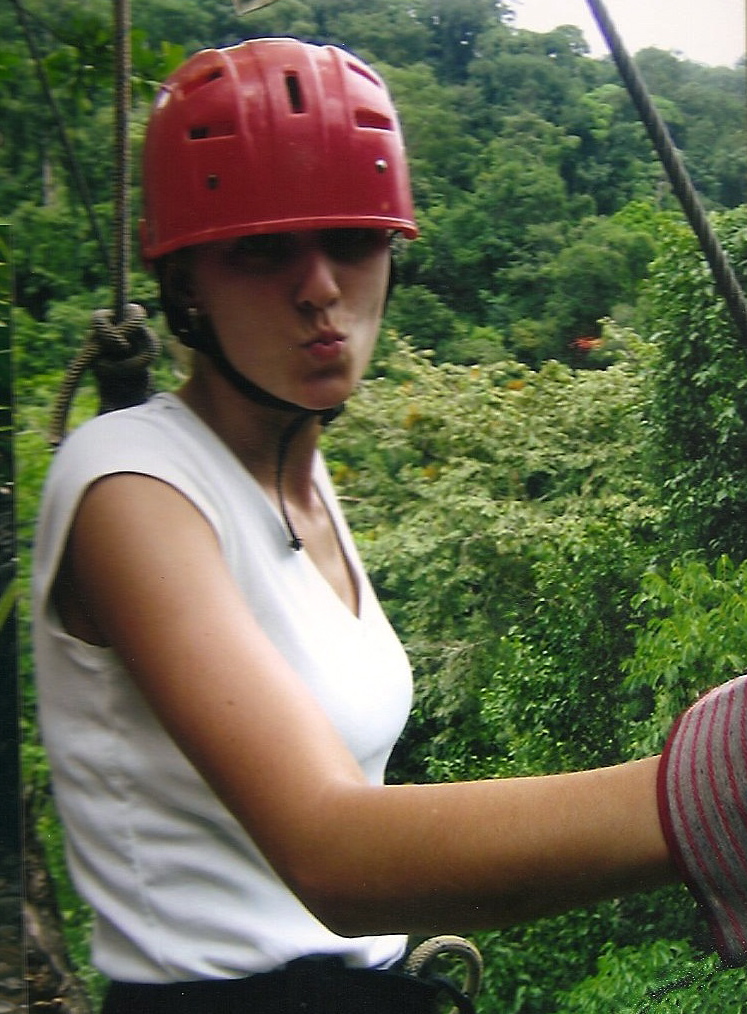
I'm smiling but the helmet tells the real story of the damage done.

For days afterwards, I couldn’t lift my head on my own to sit up. For weeks afterward, I would need Chris’s help driving me to and from work as well as with performing routine tasks. Two years later, I’m still working hard to stay on top of the residual issues with my head and neck.

This week I had an “ah-ha!” moment after my semi-weekly physical therapy treatment with Eric Oliver. In short, we figured out that I was under-using some muscles of my neck and over-using others as a result of the patterns I’d created to function and protect myself post-crash. The simple solution that I had failed to execute these two years was to create new neuromuscular (brain to muscle) pathways for my body to function in its most optimal, efficient manner.

Wow, was it really that simple? I had been doing stretching, Pilates, massage, cranial-sacral work, trigger point therapy, physical therapy (all which helped tremendously) but the thing I had failed to do was create new neuro-pathways. I mean, c’mon, recognizing the body's patterns is my job and I pride myself on quickly seeing others’ good and bad habits! How did I miss seeing this? It is with my realization that I begin to question how automatic and static my daily patterns are. How many other neural pathways have I failed to create simply out of habit and, dare I say, laziness? And, if this pattern is pervasive, how do I go about breaking through those barriers to new thinking and doing? Time will tell how effectively I’m re-training my muscles through conscious and manual activation but, yes-- it may just be that simple.

central and peripheral nervous system
For many years, even up until the last decade, science concluded that the brain wasn’t changeable and that the creation of new neurons was impossible. It was only recently that “a few iconoclastic neuroscientists challenged the paradigm that the adult brain cannot change and made discovery after discovery that, to the contrary, it retains stunning powers of neuroplasticity. The brain can indeed be rewired. It can expand the area that is wired to move fingers, forging new connections that underpin the dexterity of an accomplished violinist. It can activate long-dormant wires and run new cables like an electrician bringing an old house up to code, so that regions that once saw can instead feel or hear. The adult brain, in short, retains much of the plasticity of the developing brain, including the power to repair damaged regions, to grow new neurons, to rezone regions that performed one task and have them assume a new task, to change the circuitry that weaves neurons into the networks that allow us to remember, feel, suffer think, imagine and dream. ”


Enrique & J.Lo Chicago's United Center, 2012
It is in the same week that Chris and I ventured to Chicago to see one of our shared favorite artists, Enrique Iglesias, in concert. Dorky, I know, but his music has followed us through the 17 years of our relationship and now when we listen to it, it tells us the history of our past together. Dorky, but really romantic. 

Hours of driving to the Windy City led us to read aloud some of Chicago’s founding history. It's history tells the story of how it went from unsalvagable swamp land to an architectural and historical wonder of the Midwest. “Make no little plans”, was stated by one of the city’s founders, Daniel Burnham. It stuck out at me and AGAIN begged the question: how many of our 100 billion neurons and 100 trillion connections in the brain are we actually using? Do we continue to have a founder-like view of the world or have we stopped trying at innovation because the world looks/seems complete and we've let our brain take rest?

With my clients I often use the analogy of a path in a field that you've traveled many times. The route is visible, the grass is flattened and worn down by repeated use. It's comfortable, it's familiar, you know where it leads and what to expect along the way. A new path feels weird under the feet the first few times; you might step on something you don't like or discover something neat that you didn't know was there. You just have to travel down the new path a few times before you know how it will work for you and if you like it. Give it a chance.


The wildly amazing thing about the brain is that the more new paths in the grass you create, the more it encourages you to keep treading new territory and, before you know it, the field is covered in a web of new possibilities. So, perhaps, it's just sustaining the few uncomfortable first tries and then letting the wheel turn almost unassisted.

It's been several weeks now and I've been experimenting on myself. As is most always the case, step #1 was recognizing the issue.

Step #2 then became a mental pep-talk to the muscles on my neck. "Okay, guys you've been slacking for good a reason but it's time to go back to doing what you are meant to do."

Step #3 was encouraging new patterns in a tactile way. Each week before my long runs, Eric (or husband Chris) was taping my neck as shown below to a) encourage correct usage of my shoulder, neck, and back muscles; b) serve as a reminder when my posture or head position breaks down mid-run (the tape literally pulls and I can feel I'm off center as my head tends to float to the right);  
c) increase blood flow to the areas where the tape sits.
You've seen it in the Olympics b/c kinesio tape works wonders.
Real Ease neck cradle feels like heaven.
Step #4 has become re-enforcing the new patterns by setting my alarm to do posture checks throughout the day. Or, if pain starts to show up, immediately treating it with stretching or trigger point massage. On my short runs I've also started to rhythmically, and somewhat forcefully, tap on places of my neck that I am re-training to work a bit harder to restore balance.

And step #5 is another method of staying ahead of the curve. Chris and I have made it part of our bed-time routine to pro-actively treat our "bad" spots. He has foot issues and massages it while I put my head in my "neck cradle" which essentially takes the pressure of off my spine and into my occiputs.

The wheel is turning and I've begun to notice an improvement. Will the changes last? Who knows. Will every new pattern or way of thinking in life be this easily created? Doubtful. But, if nothing else, it becomes a fun experiment in potential. This method of creation shows me what's possible of the conscious mind. My next experiment in new behavior and changing the BIG PROBLEMS in life becomes addressing the subconscious--the thing that controls 96% of how we make decisions and whether or not new behavior sticks. But that's a beast for another blog.

Thursday, August 16, 2012

Always Trust in the Difficult

We would like to introduce you to Nancy Spence, Ph.D., author of Life Medicine: Wisdom for Extraordinary Living and creator/ facilitator of the ikigai workshop, "What Should I Do with My Life?" A great majority of our insight, and any wisdom we may have, comes from having this woman in our lives. We invited her to join us in blogging as we know you will enjoy her depth of knowledge and insight. (Luckily, she also happens to be my mom!) For more on her and her current work, check out http://www.yourikigai.com/and stay tuned for future entries.

Photograph: Electric Artists

Maybe the great poet Rainer Maria Rilke was right: "Always trust in the difficult."

Take the case of Grant Achatz. He's the wildly inventive creator who serves up olive-oil lollipops and apple-taffy helium balloons at his 3-star Chicago eatery, Alinea. According to the website Next Level, patrons vie for seating "like little monsters clobbering for Lady Gaga tickets the moment sales open." 

At age 34, Achatz was named "best chef in America." But, at age 33, things weren't nearly as upbeat. He was diagnosed with stage-four tongue cancer.  His options: Cut out a piece of his tongue...or die. Choosing an experimental treatment instead, Achatz could hardly eat and lost his sense of taste. But he courageously kept working. He shifted his focus to the smell, sight and sound of foods while his sous chefs did the tasting for him. 

During his last lecture at Columbia University, historian Charles Beard was asked to summarize in five minutes everything he had learned in a half century of teaching. Beard said he could do better: He could sum it all up in four sentences. One of his sentences was this: "The bee that robs the flower also fertilizes it."

I imagine that Achatz would concur. He says his encounter with cancer actually made him a better chef. As he healed and his taste buds returned, he noticed that he understood flavors in new and inventive ways. Now a leader in the emerging field of "molecular gastronomy," he creates cuisine described as "genre-bending." In 2011, Time Magazine named him one of the "most influential people in America"--a true "culinary miracle worker."

Rilke would not be surprised. "How should we forget those ancient myths about dragons that turn into princesses?" he wrote. "Perhaps all the dragons in our lives are princesses who are only waiting to see us act, just once, with beauty and courage."

Too often I hear clients tell me that they can't do what they love "because..." But what's embedded in their pain, difficulty, tragedy, disability or scar is an invitation to do what Achatz did: Get creative, 'think different,' go deeper, be courageous.

When they do, they too come out the other side to make their own 'wow' contribution.

Monday, August 13, 2012

Adjusting the Sails

By Chris Dwyer
 
I can't change the direction of the wind, but I can adjust my sails to always reach my destination.
-Jimmy Dean

I may not always be the proverbial king of my castle, but I am certainly the king of my kitchen. Even so, when the Lady of the Castle (my lovely wife) asks me to do the dishes, I'm totally cool with that. If I'm in the act of doing them, as I often am, and she has a helpful hint, that's fine, too. But heaven forbid, if she tells me to do the dishes and THEN tells me how to do them, I go completely berserk. Dishes almost get tossed against the wall and the wife. This is because telling me what to do plus telling me how to do it somehow hacks into my psychology's circuitry and unleashes my hellspawn-husband virus. I’m sorry-- it's terrible. I hate it. But I don't hate myself, because it's just the way God made me.
I'm not shifting blame here. In fact, I take full responsibility for having some responsibility. 

My wife and I have been working on doing a better job seeing things at a BIG-picture level. Before we blame each other, or other people, we try to see if there is a better way to design "the system". The larger system so often implicitly coerces people into doing crazy things they don't want to do. And systems usually obey very predictable behavior. So really, what I've decided to do is take full responsibility for not being in harmony with the system around me. I can either work to change myself, or I can work to change the system, or both. This strategy has helped save us (me) from countless Catherine Kieu Becker (the woman who cut off her husband's penis and threw it in the garbage disposal). 

I used to do infrared inspections for a large manufacturing facility called Bicycle Playing Cards. Un-scheduled equipment breakdowns are every plant manager's worst nightmare, so the accountants and engineers are big proponents of preventative maintenance strategies like infrared. My mandate was to keep the motors alive or else know exactly when they would die. 
Of the thousands of motors that I inspected in the plant, there was one tiny motor that was far and away more important than every other motor. It was the lynchpin of the whole factory. If it failed, the whole plant shut down. It was the vacuum motor! Without the vacuum motor, all the junk accumulated in the factory and effed-up the whole process. Las Vegas herself depended on that vacuum motor.
Our kitchen has a figurative vacuum motor-- the lynchpin of the system that could unfasten bliss at any moment. Working the system backwards, we figured out that my dishes only needed her special cleaning advice because I didn't soak them first. But I didn't soak mine first because the sink was full of her dishes because the dishwasher wasn't emptied. But I couldn't empty the dishwasher because there were too many cycling water bottles drying out on the limited countertop real estate. Water bottles were the lynchpin! 

What we needed, therefore, was a better drying mechanism and storage system for our water bottles. But that would require a larger system change upstream. Next, Susie and I sat down at the drawing board to see if we could map out a better system for our household. Here is the plan we came up within reverse order.

GOAL = Have more free time and stay married
Step 6) Stop buying (or accepting) junk into our house
Step 5) Deeply, quickly, and even impulsively get rid of the junk we already have
Step 4) Get rid of our TV from TV cabinet 
Step 3) Retrofit TV cabinet into a "recreation locker"
Step 2) Find home for water bottles
Step 1) Empty dishwasher in the morning and load/run it at night

All the crap that's normally spews across the floor after a workout has a proper home now

Water bottle clutter almost ruined our marriage until they found a home


Tuesday, July 24, 2012

Evolution of a Runner: Answering the Question of Why Anyone Would Aim to Run 50 miles


By Susie Crossland-Dwyer

Recently, I read one of my favorite books of all time, Robin Harvie’s, The Lure of Long Distances: Why We Run. For several years, since taking over 15 hours to complete my last major race (IRONMAN Louisville), I’ve been struggling to put language to the way I feel about long-distance running and endurance sport. This book nailed my exact sentiments and confirmed that I’m not crazy--a word I hear almost daily to describe the types of races for which I enjoy training.

In September I will attempt to complete my first ultra-marathon. Technically, an ultra is anything over the 26.2 miles (a typical marathon) but most ultra runners consider 30 miles to be the point of demarcation between regular and ultra-marathoning. To make my North Face Endurance Challenge race official, I will have to finish 50 miles of running/walking in 13 hours. Although, as Harvie states, “there will always be a gap between what it sounds like and what it feels like,” I’ve been asked the question of why so many times that I’ve decided to finally answer it completely. 

Ault Park, Cincinnati running 2011
 If you want the short version, read no further: I run long distances primarily to be a better person and to get more out of life. It gives me the space to process and to imaginatively manifest my future. So, if you see me out running, just assume I’m loving myself, you or the world a little more because of it. “Running…is simply about becoming a more sentient person living…an authentic life.”

The longer version of why is more nuanced.

I started running because of a failure. After a single year of play, I had been cut from my high school soccer team. It was blow to the ego--a big blow. From age five, I had spent my childhood preparing/ dreaming of becoming a pro in women’s soccer. I clung tightly to that image of my future even though all along I knew I wasn’t “good enough.” 
Ursuline Lions Cross-Country 1999
So I started running cross-country instead. Honestly, I was pretty bad (slow!) at that too, but it didn’t matter. I was moving on and moving forward. Even before cross-country I was oddly passionate about fitness. I would rush to the Cincinnati Sports Club directly after school to workout for hours on end. I would run around my block over and over late at night when the rest of the world was already asleep. I would get up early on beach vacations to run the sand. I would read books like The Complete Book of Women’s Running and The Ultimate Sports Nutrition Handbook. I would look forward to hill climbing in Mt. Adams or kickboxing with my high school health class. Senior year, I was even voted as most likely to make a fitness video.

Back then, I’m not sure I even loved the act of running that much. But I now know I’m an introvert and very sensitive to my surroundings. During those years, I believe I was creating a guaranteed escape from my day that allowed my introverted nature to reset itself. “A means of escaping the perpetual noise of everyday life and finding a space to think.” Even more obvious than that, I was getting nudges from the cosmos on which direction I should head in life.

In subsequent years, running would carry me through a lot of life lows. It would see me through temporarily loosing the love of my life to the seminary, through feeling very alone about my sensitivities and place in the world, through a college experience that isolated me even further, through questions about what I was supposed to do with my life and, once finding my purpose, through many hard days of reconfirming my commitment to it. It would provide me with glimpses of truth about my universe; that I would have true love again, that feeling different would ultimately serve as blessing and that I would find my stride in life. Running during those low, tough periods gave me slivers of confidence, consistency, and focus.

Chicago Marathon, 2001
In 2001, long before I knew anyone who had completed a marathon, I would finish my first in Chicago. Although I had no idea what I was getting into or the future home it would provide for me, Chicago Marathon whispered it’s magic in my ear and told me to keep down the running path. For the first time, even though I wasn’t sure what it meant, I recognized that “the legs are much easier to train…the mind is more complicated.”

Fast forward, many miles and races later to 2008. Having never completed a triathlon of any distance, I signed up for IRONMAN. 2.4 Miles of swimming, 112 miles of cycling and 26.2 miles of running—the pinnacle race of the triathlon world. It wasn’t because I was already in love with the sport or even that I knew anyone racing at this level. It was my gut. It was a stronger version of the whisper I had heard years earlier in Chicago. It was telling me to go for it. For one of the first (of what would become many) times, I listened to that voice without reason or second thought.

IRONMAN gave me many gifts. First, the training expanded my view of what is possible. During the height of training I fought through weeks of waking up each day feeling as if I had mono. I would get out of bed everyday at 4:30AM and say out loud the words “you can do this.” I was personal training my clients up to 13 hours a day and triathlon training myself up to 4 hours a day. You do the math. But, despite my fatigue, I was making progress in both my training and my career like never before. I didn’t just have goals; I had immense passion for my goals.

Louisville, KY training for IRONMAN, 2009
This phase was a building block in my life that helped me know--on a cellular level--that I could do anything I had passion for and set my mind on. In the years to come, I would have to call on this knowledge many, many times over as Chris and I made the transition to building, owning and operating his business emotiv & mine studio s.
As ultra-running legend, Scott Jurek, points out in his memoir Eat & Run, “Overcoming the difficulties of an ultra-marathon remind me that I could overcome the difficulties in life, that overcoming difficulties was life.”

The racing of IRONMAN also taught me about a region of human functioning, best found through repetitive motion and physical exertion, which I had never experienced before. A zone that to this day remains somewhat indescribable. I’ve begun to call it “the truth zone.” It is a place in time and space where all of the crap in life is wiped away and you can see what you need to see clearly. It gives you truths about yourself, others and the universe. “Motion has a meditative quality, an ability to slow down the rhythm of our lives, enabling us to regain an elemental foundation of self knowledge and acceptance.”

It was IRONMAN that first introduced me to the truth zone. After 14+ hours of swimming, cycling and running at high heart rates, there came a section of my race where I was reaching the “out” section of the “out and back” run course.  It was almost 11PM, most of the competitors were already celebrating their finishes, and I was counting on one more citing of my family before I headed toward the finish line. I looked around in the darkness (the only light was a race-mandated glow necklace for safety) and I realized I was really alone. There were no course officials, no other athletes and no family. I was completely alone.

And then, it hit me…I was alone…as an individual. No one in my life had entered into this world with me, no one would go through my final moments with me (whenever they might be) and so why had I been so concerned all these years about what others might think or do in between the beginning and the end. The journey was all mine. Any fears or doubts I had about owning this path would be okay. “To become true long-distance runners, we must accept that we are completely on our own. Only after we have unshackled ourselves from that place of safety can we say that out there, in whatever state we end up, is where we belong.”

Some call this phenomenon “satori—the sudden Zen-like clarity that comes when you least expect it, often when your body is pushed to the limit.” Call that moment (and many others like it) fatigue, lack of calories, darkness, satori or whatever else. It doesn’t matter what you call it. What does matter is that it was a moment that continues to influence how I live. I had found “the part of me that…[was] bigger than the pain [of IRONMAN].” Less than hour later, after 140.6 miles, I would cross the finish line and instead of tears, as I anticipated, I had a smile that couldn’t be wiped away for weeks. “Susie Crossland-Dwyer, YOU are an IRONMAN.”

IRONMAN Louisville 2009, Not my official finish time but the official finish line!
My reasons for running continue to evolve and intrigue me. “There is no ascetic state in which we can remain for all time, forever transcended out of our everyday lives.” But at this stage of evolution my primary motivation is to inhabit “the truth zone” as often as possible. And, I do, more and more easily (not just with long distance) the more I run. As Harvie writes in Why We Run, it is in these moments I feel the most alive, the closest to what Emerson in his work Nature calls “the universal eye.” I run the miles to be in moment and discover what awaits me.

Is it addiction, is it meditation or is it a realm humans are meant to spend time in (and most likely have for the majority of human history)? For me, it’s an awareness that “the most obvious good is an increased knowledge of our own capacities. By trying with all our might and with all our mind…we are getting to know better what we can really do…if…we reach the…[end], we shall know that we are capable of more than we had supposed.” The more I know my own capabilities the more I can see the potential in others.  

With the clear lens of retrospective time, I see that human potential has always captivated me. At 13, I started self-studying world religions by gobbling up as many books as I could on the topic. I would go on to make Comparative Religion my degree because I wanted to know how religion influenced and motivated individuals as well as cultures. I started a life coaching company, ikigai (a Japanese word defined as “that which makes life most worth living”) with my mom to help others seek out their potential through their passions. And, studio s would become the manifestation of both my internal and external workings of potential—as well as a hopeful breeding ground for others to discover their own.

Nike Women's Marathon, SanFrancisco, 2011
It was with all of these insights that I set out to make 2012 the year of running. The goal was simple: get lost in the art of running. So, although I hope running my 50 mile ultra brings me a finish, I also hope it continues to bring me new challenges and insights for the head, heart and spirit. “Becoming an ultra distance runner involves a merging of consciousness and landscape, while offering up the possibility of going beyond limits of our knowledge. The transformation is in the act of running itself, which turns from a mode of travel—in it’s most limited form, of getting across the finish line—to a mode of being.”

Jurek ends his book with the words I’d like to leave you with. “You can be transformed. Not overnight, but over time. Life is not a race. Neither is an ultramarathon, not really, even though it looks like one. There is no finish line. We strive toward a goal, and whether we achieve it or not is important, but it’s not what’s most important. What matters is how we move toward that goal. What’s crucial is the step we’re taking now, the step you’re taking now.”


Sunday, July 8, 2012


This blog is simply to remind ourselves of the way we WANT to live and to share it with our friends & our community. Our philosophy is simple and it's our hope that you will share in it with us.

MOVE
It doesn't matter how, what, when or why but movement is something that gives us energy and makes everything else we do sustainable. It is more than exercise, healthy living, or even weight management--it is a space in the day to process, create and be.

RESPECT
Any form you can think of, that's what we mean. Self. Nature. Others. Planet. Community. Partner. 

LIVE
At the end of every day we look at each other and mutter the words, "It's going too fast!" Life that is.
So, let's adventure, pursue our passions, travel, learn or whatever else we come up with.